

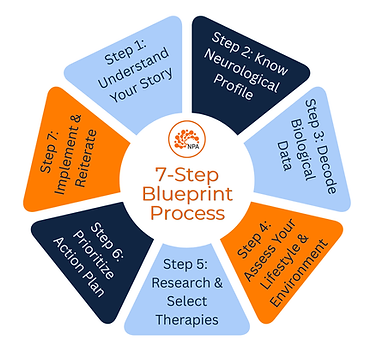
NPA’s 7-step Blueprint Process Was Designed to Help Caregivers and Individuals Understand Their Unique Health Challenges and Strengths, Evaluate Treatment Options, and Advocate for Applied Neuroplasticity-Based Care
It is grounded in the real experiences of people who refused to accept the status quo in their healing journey and instead, took a proactive role in researching neuroplasticity-based approaches, asking better questions, and advocating for additional options. The Blueprint combines those lived insights with the practical framework healthcare providers use to assess care and guide decision-making. Because neuroplasticity has only recently become part of formal medical training—and because new therapies often take time to become widely adopted—you may need to play an active role in identifying and exploring interventions that could support your recovery. This process helps you navigate those steps, and most importantly, puts YOU in the driver’s seat, helping you become an informed, active partner in your recovery while working in tandem with your medical team to build a plan tailored to your unique needs.
A Simple 7-Step Cycle

Understand Your Story
Document your life before and after the onset of symptoms or injury to identify patterns, strengths, and contributing factors.

Know Your Neurological Profile
Clarify and understand your diagnosis, explore how the affected brain areas and relate to your symptoms, and document any remaining questions.

Decode Your Biological Data
Review lab work and advanced testing to uncover additional root causes such as inflammation, nutritional deficiencies, or other factors that may be blocking healing.

Assess Your Lifestyle & Environment
Evaluate daily habits, nutrition, sleep, stress, toxins, and surroundings that influence your natural neuroplasticity capacity.

Research & Select Therapies
Explore evidence-based therapies and programs that leverage neuroplasticity with your care team (see Therapy Navigator below).

Prioritize Your Action Plan
Choose 1–2 high-impact steps and create a realistic, prioritized plan.

Implement & Reiterate
Take consistent action, track progress, and repeat the cycle as your brain continues to adapt.

.png)
.png)
.png)